How to Ship Lithium Batteries & Power Banks from China to Germany: The Complete 2026 Guide (Air, Sea, Rail & DDP)
· By SinoShipment
If you are trying to figure out How to Ship Lithium Batteries & Power Banks from China to Germany, start with one assumption: this is not a normal general cargo move. Lithium batteries and power banks are treated as Class 9 Dangerous Goods in many shipping scenarios, which means the shipment can go off track long before it reaches Germany if the classification, documents, packaging, or carrier approval are wrong.
Experienced importers usually do not start with “What is the cheapest rate?” They start with “What exactly am I shipping, what UN number applies, and which route will a carrier actually accept?” If you are planning broader freight shipping from china to germany, battery cargo should be treated as a higher-control subset of that route rather than a routine shipment.
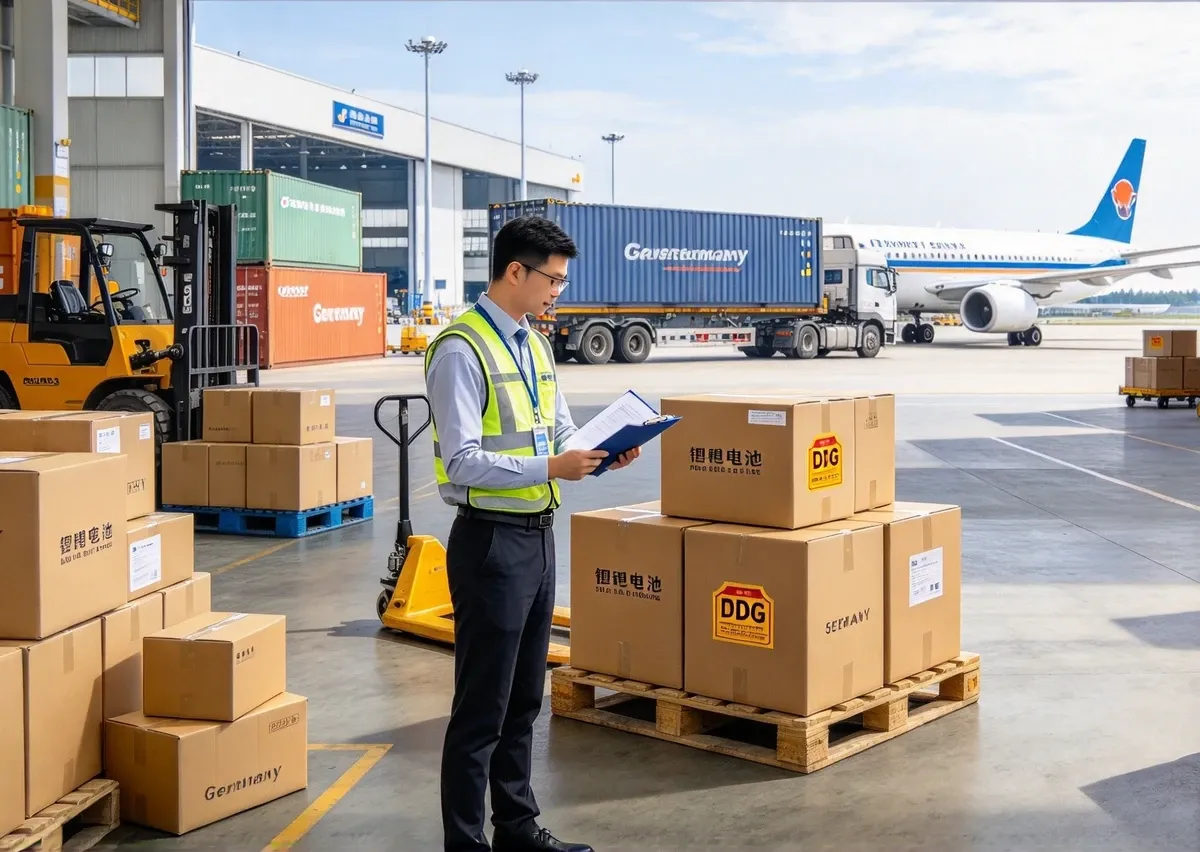
Why Lithium Battery Shipping Requires Special Handling
Lithium battery cargo receives extra scrutiny because the main transport risk is thermal runaway. A battery that is poorly packed, short-circuited, physically damaged, or declared under the wrong category can overheat, ignite, or be rejected by the airline, shipping line, terminal, or customs authority.
For 2026 shipments from China to Germany, three rule layers matter most:
- Air transport rules, especially the current IATA Dangerous Goods Regulations
- Sea freight rules, mainly the IMDG Code
- EU and Germany market-entry rules, including labelling, importer registration, and customs compliance
This is where many buyers get caught. A battery shipment can look simple on paper, then turn expensive the moment the warehouse asks for the actual battery model, the airline asks for DG confirmation, or the carrier refuses the booking because the cargo is really UN3480 rather than ordinary electronics.
How to Ship Lithium-Ion Batteries From China to Germany: Identify the Battery Type and Configuration First
Before you ask for a booking, identify the battery chemistry and the shipping configuration. The same product can move under different rules depending on how it is packed:
| Battery Type | Configuration | Typical UN Number | Main Question |
|---|---|---|---|
| Lithium-ion | Shipped alone | UN3480 | Is the battery moving without the device it powers? |
| Lithium-ion | Packed with equipment | UN3481 | Is the battery in the same carton but not installed? |
| Lithium-ion | Contained in equipment | UN3481 | Is the battery installed in the equipment? |
| Lithium-metal | Shipped alone | UN3090 | Is it a standalone primary battery? |
| Lithium-metal | With equipment | UN3091 | Is it packed with or installed in equipment? |
| Sodium-ion | Alone / with equipment | UN3551 / UN3552 | Does sodium-ion classification apply? |
How to ship power banks from China to Germany
This is where many first-time shippers go wrong. A power bank may look like a consumer electronics accessory, but in transport terms it is usually classified as a standalone lithium-ion battery rather than as equipment containing a battery. In many practical shipping reviews, that means it is often assessed under UN3480, subject to the product design and transport configuration.
That distinction matters because UN3480 often faces stricter air restrictions and closer carrier review than ordinary electronics.
What to confirm with the supplier before shipping
Ask for the battery model, chemistry, voltage, capacity, Wh rating, label photos, packaging photos, and the exact shipping configuration before paying the final balance.
If the product is a power bank, do not let the supplier describe it vaguely as “electronics” on the shipping documents. That kind of shortcut often creates rejection problems later.
UN38.3 Test Summary Requirements for Shipping Batteries to Germany
For most lithium battery shipments, UN38.3 is not a nice extra. It is a core compliance requirement that shows the battery type passed the transport safety tests used across the dangerous goods system.
What UN38.3 actually proves
The summary has to match the real shipment: manufacturer, battery or cell model, chemistry, voltage, capacity, Wh rating or lithium content, and test report details. A UN38.3 file for another model from the same factory is not enough, and this is one of the mistakes that causes avoidable warehouse holds.
MSDS/SDS requirements for lithium battery shipping from China to Germany
A surprising number of suppliers still send an MSDS or SDS as if that settles the transport question. It does not. An SDS may still be requested, but it is not the same as a dangerous goods declaration and it does not replace correct classification.
Think of the documents in layers:
| Document | What It Does | What It Does Not Do |
|---|---|---|
| UN38.3 Test Summary | Proves the battery type passed required transport tests | Does not replace booking or carrier approval |
| SDS / MSDS | Provides chemical safety information | Does not replace DG transport documents |
| Commercial Invoice & Packing List | Supports customs and cargo details | Does not confirm DG classification |
| DG Declaration / Shipper’s Declaration | Declares regulated dangerous goods for transport | Does not replace product testing |
A simple supplier document review checklist
Before cargo leaves the factory, compare the documents against the physical goods:
- Does the battery model on the file match the label on the battery?
- Do the voltage, capacity, and Wh figures match?
- Is the battery chemistry described correctly?
- Is the shipping configuration described correctly?
Real-Life Scenario
One mistake we see surprisingly often in South China is a supplier sending a valid UN38.3 file for last season’s battery model while the new batch uses a different cell supplier. The paperwork looks fine until the warehouse compares the carton label with the report and notices the mismatch. That is usually the moment the shipment stops moving.
IATA DGR 2026 Lithium Battery Shipping Rules China to Germany
air freight is usually right for urgent, high-value, or e-commerce replenishment cargo. It is also the mode that demands the most discipline. If you want a broader benchmark for market conditions, our guide to Air Freight from China to Germany can help you compare this battery-specific process with standard air cargo planning.
PI 965 vs PI 966 vs PI 967 lithium battery air freight
For lithium-ion cargo, the key packing instructions are PI 965 for batteries shipped alone, PI 966 for batteries packed with equipment, and PI 967 for batteries contained in equipment.
30% state of charge rule lithium battery air freight 2026
For 2026 air shipments, the State of Charge (SoC) rule is one of the most important checks:
- UN3480 shipments typically need to be offered at 30% SoC or below
- PI 966 shipments also require careful review because 2026 guidance is tighter than many older articles suggest
- PI 967 shipments may still be treated differently, but low charge levels are often strongly recommended and airlines may add stricter internal rules
Air freight lithium batteries China to Germany: which airlines accept?
There is no single battery air route that works for every shipment, even when the products look similar on paper. Acceptance depends on chemistry, UN number, Wh rating, package quantity, route, and origin airport. A route that worked last month from Shenzhen may not be available this month from Hong Kong or Shanghai if the operator changes its policy.
Sea Freight Lithium Batteries China to Germany Cost and Transit Time
For larger and heavier shipments, sea freight is usually the most practical starting point, especially for multiple pallets, full containers, or repeat replenishment orders. For non-battery baseline transit planning, you can also compare this workflow with Shipping from China to Germany by Sea.
Typical China-to-Germany transit planning depends on the route, carrier, season, DG acceptance, transshipment pattern, and customs processing. In practice, many forwarders use planning ranges like these rather than guaranteed service standards:
| Mode | Typical Transit Profile | Best For | Main Limitation |
|---|---|---|---|
| Air Freight | 3-7 days airport to airport | Urgent shipments | Highest cost and strictest acceptance |
| Sea Freight | 25-35 days port to port | Heavy or regular volume | Longer lead time |
| Rail Freight | Around 15-20 days terminal to terminal | Mid-speed planning | Route and acceptance variability |
| Express Courier | Fast for eligible small parcels | Small compliant consumer shipments | Strong size and acceptance restrictions |
FCL vs LCL for battery cargo
If you are comparing FCL and LCL, the decision is not only about volume. It is also about control and dangerous goods handling.
| Option | When It Works Best | Operational Advantage | Watch-Out |
|---|---|---|---|
| FCL | Larger DG cargo or stable repeat orders | Better control, fewer touch points | Higher minimum cost |
| LCL | Smaller shipments from multiple suppliers | Better for lower volume importers | More handling and stricter consolidation review |
Indicative cost logic
Battery freight pricing changes constantly, but this logic is useful for budgeting:
| Channel | Typical Cost Pattern | Notes |
|---|---|---|
| Air DG cargo | Highest cost per kg | Includes DG handling and airline surcharges |
| Sea LCL DG cargo | Charged by volume plus DG fees | Good for smaller commercial batches |
| Sea FCL DG cargo | Better unit cost for larger volume | Good for repeated orders or heavy batteries |
| Rail / truck combinations | Middle ground between air and sea | Useful when timing matters but air is too expensive |
The cheapest compliant route is usually not the headline rate. It is the route that balances freight cost, handling risk, customs readiness, and carrier acceptance. Rail can be a strong middle option, while courier services may work only for certain small compliant battery shipments.
German Customs Clearance Process for Lithium Battery Imports From China
A shipment can leave China smoothly and still get stuck in Germany if the importer side is weak. In real projects, strong customs clearance support is often the difference between a routine release and a costly delay.
EORI number required to import batteries into Germany from China
For most commercial imports, the importer needs an EORI number for EU customs processing. This is not something to leave until the cargo is already in transit. When it is handled too late, the result is usually not a dramatic customs dispute, but something more annoying: avoidable delays, document amendments, and storage charges that were never in the original budget.
What German customs will care about
For lithium batteries and power banks, the German and EU side normally reviews the importer identity, HS Code, invoice accuracy, declared value, transport documents, and product compliance readiness. In practice, vague product wording causes problems more often than importers expect. If the invoice says “electronic accessories” when the shipment is clearly battery cargo, the file will attract the wrong kind of attention.
Lithium battery import duties and VAT Germany 2026
Germany typically applies 19% VAT on importation. Duty depends on the final product classification, battery type, and the declared HS code. Some battery products and battery-powered products do not fall under the same customs treatment, so do not assume that “all batteries” share one duty rate.
Germany-specific compliance points importers often miss
- German-language product labelling where required
- CE marking for applicable products
- BattG obligations for batteries entering the German market
- VerpackG for packaging responsibility
- ElektroG for electrical equipment where applicable
- ICS2 advance data accuracy for EU entry screening
Our Industry Insight
Germany usually moves smoothly when the paperwork is clean. Delays start stacking up when shippers treat it like a generic EU destination, use broad product descriptions, or wait too long to decide who actually owns the compliance side.
EU Battery Regulation 2026/2023 Compliance for Chinese Battery Exporters
Shipping compliance and market compliance are not the same thing. A shipment can be ready to move and still be weak on the product-compliance side once it reaches the EU market. That is where many teams realize too late that transport documents and market-entry obligations are two different jobs.
What changed in practical terms
For 2026 and beyond, importers need to watch expanded battery labelling, product traceability, EU Authorised Representative arrangements, EPR, and future Battery Passport obligations. This matters most for companies that sell under their own brand in Europe, because the compliance burden does not stop at customs clearance.
Different products face different compliance pressure
| Product Type | Main Compliance Focus | Key Risk |
|---|---|---|
| Power banks / consumer lithium batteries | Labelling, product data, market readiness | Treated too casually because they are small |
| E-bike / LMT batteries | Higher scrutiny and future digital passport obligations | Misclassification and weak technical documentation |
| ESS / BESS / EV battery packs | Strongest regulatory burden | Carbon, traceability, and acceptance complexity |
How to prepare as a Chinese exporter or German importer
Start early, especially if you sell under your own label in Germany. Confirm the battery category, audit the label before packing, define who holds EU compliance responsibility, and check whether the product line will later need Battery Passport readiness. This is much easier to do before the first shipment than after your distributor or marketplace asks for missing compliance information.
DDP Shipping Lithium Batteries From China to Germany Door to Door
For many first-time importers, DDP (Delivered Duty Paid) is the easiest structure to understand. Instead of coordinating every step separately, you use one integrated logistics solution that covers pickup, export handling, international transport, import processing, and final delivery.
When DDP makes sense
DDP shipping lithium batteries from China to Germany door to door is often the right choice when:
- You do not have a strong customs or compliance team in Germany
- You need one all-in project manager
- You are buying from multiple Chinese suppliers
- You want a clearer landed-cost view before ordering
- You are shipping to e-commerce warehouses or fulfillment centers
What DDP should cover in battery logistics
A proper battery-focused DDP solution may include factory pickup, document pre-check, DG packaging coordination, export customs handling, international transport, destination customs coordination, duties and VAT handling, and last-mile delivery.
Amazon FBA lithium battery shipping China to Germany
If the final destination is an Amazon or e-commerce fulfillment network, DDP becomes even more valuable because it can combine consolidation, labelling support, warehouse staging, appointment-based delivery, and shipment splitting by SKU or carton plan. This is also where dedicated amazon fba support becomes valuable for battery-powered products moving into marketplace inventory.
Real-Life Scenario
An e-commerce seller buying power banks from Shenzhen and Dongguan rarely wants to coordinate two factories, a DG warehouse, an airline, a customs broker, and a German delivery partner one by one. When nobody owns the handover points, small problems multiply fast: the labels are not ready, the booking is delayed, or the cargo reaches Germany before the importer paperwork is in place. A battery-capable DDP setup reduces those gaps and gives the seller one operating line instead of five.
Sinoshipment is well positioned for this kind of move because battery logistics from China usually requires local coordination near manufacturing clusters, ports, and airports.
Why Was My Lithium Battery Shipment Rejected by the Airline or Carrier?
Most rejected shipments fail for predictable reasons, and nearly all of them can be reduced with a proper pre-check. The frustrating part is that many of these failures are not technical mysteries. They are ordinary coordination mistakes that show up again and again.
| Failure Point | What Happens | Likely Cost Impact | Best Prevention |
|---|---|---|---|
| Wrong UN number | Booking refusal or cargo hold | Rebooking, storage, document correction | Confirm chemistry and configuration before quoting |
| UN38.3 does not match actual goods | Warehouse or carrier rejection | Delay, repacking, missed flight or sailing | Match model, voltage, capacity, and label details |
| Power bank declared as ordinary electronics | Reclassification required | Extra handling and delay | Treat power banks as battery cargo from the start |
| SoC too high for air cargo | Airline refusal | Missed uplift and warehouse fees | Confirm charge level before factory release |
| Weak insulation or non-compliant packing | DG acceptance failure | Repacking cost and delay | Use battery-specific packing review |
| No written carrier approval | Last-minute refusal | Rolled cargo and higher freight | Get route-specific acceptance in writing |
| Weak German importer setup | Customs stop or release delay | Storage, demurrage, document amendments | Confirm EORI, invoice data, and compliance ownership early |
What happens if a lithium battery shipment is stopped at German customs?
The outcome depends on the reason. Customs may request more documents, hold the cargo for clarification, or reassess the declaration. The longer the shipment stays unresolved, the more likely you are to face storage and delay costs.
Lithium battery shipping insurance from China to Germany
Insurance does not fix compliance mistakes, but it still matters for high-value cargo, multi-leg transport, warehouse handovers, and urgent replacement shipments. Good insurance planning should sit next to, not instead of, compliance planning.
FAQ
Can I ship lithium batteries through DHL from China to Germany?
Sometimes, but only for certain small compliant shipment profiles.
Are power banks treated as UN3480 or UN3481?
In most standard cases, power banks are treated as UN3480.
Do I always need an MSDS or SDS to ship lithium batteries?
Not always as the defining transport document, but many operators still request it as supporting information.
Is air freight or sea freight better for power banks to Germany?
Air freight is better for urgent small orders. Sea freight is better for heavier or repeat replenishment cargo.
Do I need an EORI number before cargo arrives in Germany?
In most commercial import cases, yes.
Can I use DDP if I do not have a German company?
Often yes, but the final structure depends on the shipment and importer setup.
What is the cheapest compliant route?
Usually the route that avoids rework, rejection, and customs delays, not simply the lowest quote.
Can Sinoshipment handle pickup in China and delivery in Germany together?
Yes. This is a common structure for battery cargo involving multiple suppliers and DG review.
The safest way to move lithium batteries and power banks from China to Germany is to follow a simple order: classify the cargo correctly, verify the documents against the real battery, choose a channel that the carrier will actually accept, and prepare Germany-side customs and compliance before the goods depart. If you already have the battery specs, Wh rating, package details, and destination postcode, Sinoshipment can review the shipment structure and help you choose the most practical route.