How to Ship Ceramic Tiles & Building Materials from China to Tanzania: The Complete 2026 Guide (FCL, LCL & PVoC)
· By SinoShipment
How to ship ceramic tiles & building materials from China to Tanzania is really two problems in one: moving heavy, fragile freight across the Indian Ocean, and clearing Tanzania’s pre-shipment conformity rules before your container ever leaves China. Get the second one wrong and a perfect container can still be rejected at Dar es Salaam.
The importers who move this cargo smoothly share one habit. They plan loading, conformity, and landed cost together, before they book. Here is how to work in that order, from the Foshan tile factory to the job site.
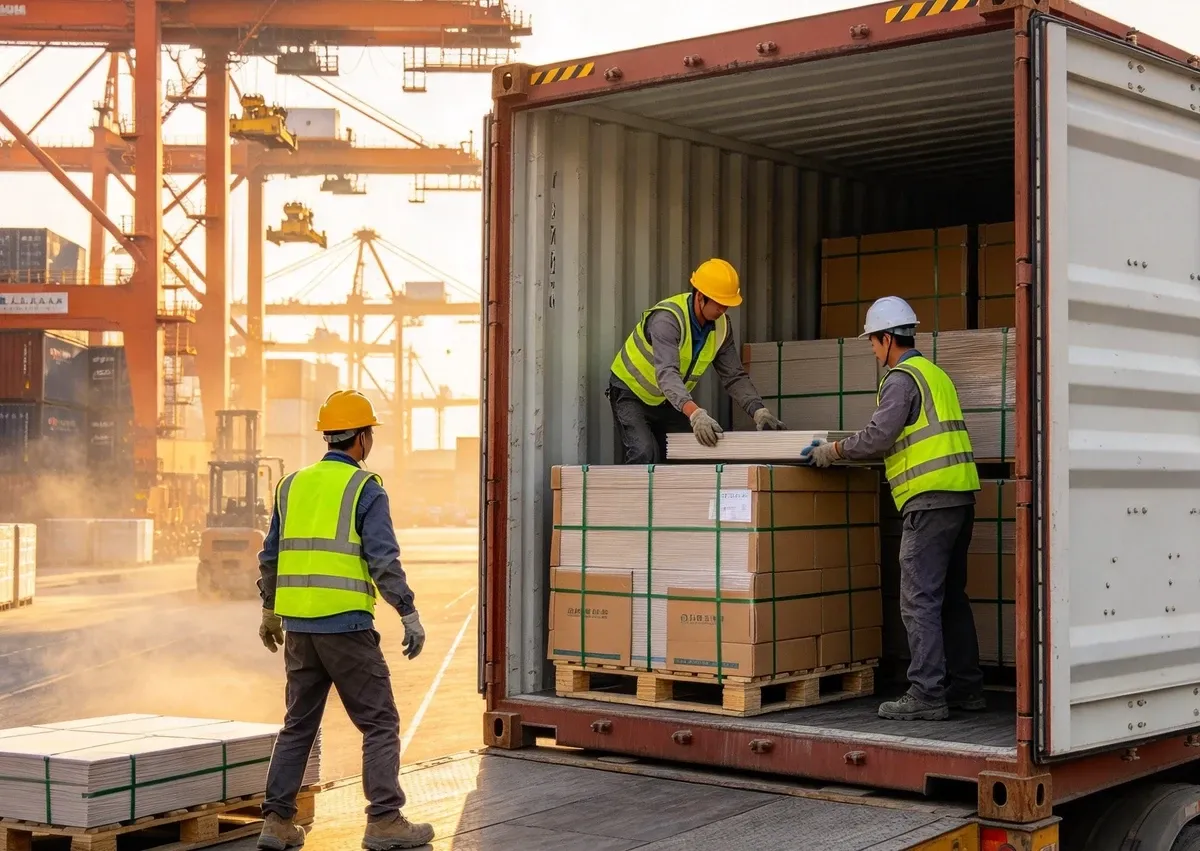
Why Ship Ceramic Tiles & Building Materials from China to Tanzania?
China is the world’s largest building-materials supplier, and Tanzania is one of its fastest-growing customers. Bilateral trade reached USD 11.28 billion in 2025, up 27% year on year, with Chinese exports to Tanzania alone at USD 10.53 billion, led by steel, machinery, and building materials.
On the demand side, Tanzania is in the middle of a construction push. The Standard Gauge Railway (SGR) program, the expansion of Dar es Salaam Port, hydropower projects, affordable housing, and Zanzibar’s development pipeline are all pulling in materials. Tanzania’s building-materials market is forecast to grow at roughly 6.5%–7% a year (2025–2029).
There is one nuance most guides skip. Tanzania now has a tile-production surplus. Local plants run capacity that exceeds domestic demand, and the surplus is exported to Kenya, DRC, Malawi, Zambia, and Uganda. Local factories already cover standard formats, so imports concentrate on large-format porcelain slabs, special finishes, and specialist materials that local lines do not produce. That shapes how you source, and which SKUs are actually worth shipping.
“Building materials” is shorthand for a wide range. A single order may mix heavy porcelain tiles (HS 6907/6908), cement (2523), steel bar and sections (7213/7214/7308), aluminum windows (7604/7610), glass (7005/7007), sanitary ware (6910), and prefabricated structures (9406). Each behaves differently in a container and at customs, yet they all move along the same Freight Shipping from China to Africa corridor feeding the region’s building boom.
How to Ship Ceramic Tiles & Building Materials from China to Tanzania: Step by Step
Nine stages. Treat them as one timeline — not two separate checklists.
| Stage | What Happens | Who Drives It |
|---|---|---|
| 1. Order readiness | Confirm Incoterm (EXW/FOB/CIF/DDP) and collect carton weights, pallet counts, tile specs | Buyer + supplier |
| 2. HS classification | Confirm tile/material HS codes early | Buyer + forwarder |
| 3. Mode choice | Sea freight for commercial volume; air only for samples | Forwarder |
| 4. Consolidation | Merge multi-supplier cargo in one China warehouse | Forwarder |
| 5. PVoC/CoC | Start Tanzania conformity before shipment | Forwarder + agency |
| 6. Export clearance | File China export declaration, confirm booking cut-offs | Forwarder |
| 7. Ocean freight | FCL/LCL to Dar es Salaam | Carrier |
| 8. Import clearance | Licensed CFA files via TANCIS; duty/VAT paid | Tanzania CFA |
| 9. Delivery | Inland trucking to site, store, or transit onward | Local trucker |
Step 5 is the one that separates a fast import from an expensive one. A Certificate of Conformity issued after the vessel sails is worth far less than one issued before loading, and Tanzania’s rules reward the forwarder who starts it early.

Our Industry Insights — the load plan is the shipment. In our experience on East Africa tile lanes, the biggest avoidable loss is not the freight rate. It is overloaded or badly braced containers. We weigh and plan every pallet before the box is picked up, photograph each staged load, and record the seal number. Months later, when a buyer claims breakage, that photo set is what turns a dispute into a fast settlement.
Choosing the Right Container: Weight vs Volume
Most importers get the container wrong here, and it is not their fault. Tiles are weight-limited, not volume-limited.
A standard 20GP loaded with 9mm 600×600mm porcelain tiles (about 960 boxes) weighs roughly 26,880 kg. That sits at, or near, the ~27.5-tonne payload ceiling, and the container is still only about two-thirds full by volume. You cannot add more. A 40-foot container does not solve this either, because its payload is lower, not higher. You simply waste space.
Two-thirds full is the ceiling, not a suggestion.
| Container | Usable Volume | Typical Payload | Best For |
|---|---|---|---|
| 20GP | ~28 CBM | ~27–28 t | Tiles, stone, steel, cement (heavy, dense) |
| 40GP | ~56 CBM | ~26.5 t | Doors, windows, panels, insulation |
| 40HQ | ~68 CBM | ~26.5 t | SPC flooring, plywood, ceiling panels (light) |
| Flat rack / open top | Oversized | Project-based | Large slabs, steel structures |

FCL vs LCL for Shipping Tiles from China to Tanzania
For tiles, FCL is almost always the right call. Your cargo is loaded once at origin, sealed, and not touched again until Tanzania, which is the best protection you can buy for fragile, high-density goods. Our FCL shipping from China to Tanzania guide covers the full booking and loading process.
LCL only makes sense for genuinely small top-up orders (mixed fittings, hardware, samples). Beware the billing. LCL follows a weight-or-measure rule (1 CBM = 1,000 kg), so dense tiles are charged by weight, not volume. Two cubic meters of marble tiles weighing around 4,600 kg is billed as 4.6 CBM, more than double the space they actually occupy.
Sea Freight from China to Dar es Salaam: Ports, Routes & Transit Times
Commercial sea freight carries virtually all tile and building-material volume. Match your China port to the factory’s location to cut inland trucking. Shenzhen (Yantian/Shekou) and Guangzhou (Nansha) serve Foshan ceramics; Qingdao and Tianjin cover Shandong and Hebei steel and glass; Ningbo and Shanghai handle Zhejiang hardware and Jiangsu prefabrication.
On the Tanzania side, Dar es Salaam is the gateway. It handles over 90% of the country’s international trade and also serves landlocked neighbors. Tanga and Mtwara are secondary options, usually reached via transshipment.
| Route (China → Dar es Salaam) | Port-to-Port Transit |
|---|---|
| Shenzhen / Guangzhou | 25–30 days |
| Shanghai | 30–35 days |
| Ningbo | 30–40 days |
| Qingdao / Tianjin | 35–45 days |
Transit times shift with routing and season, and our how long does shipping take from China to Tanzania breakdown explains the moving parts.
Plan around two 2026 realities. First, Dar es Salaam vessel congestion has been running around 14.7 days for berthing cues, so build buffer into your schedule. Second, the SGR rail now moves cargo inland from Dar es Salaam toward Morogoro, Makutupora, and on toward Tabora and Kigoma, which is steadily improving inland lead times.

Door-to-Door Shipping of Building Materials from China to Tanzania
For buyers without a local customs presence, a door-to-door (DDP/DAP) model bundles everything into one contract: factory pickup, China export clearance, ocean freight, Tanzania import clearance, duty and VAT, and final delivery. It is the simplest way to buy a tile container when you do not want to manage three different vendors. Our freight shipping from China to Tanzania route overview summarizes the service.
Shipping to the Central Corridor (Zambia, DRC, Rwanda, Burundi)
Dar es Salaam is also the port for transit cargo headed to Zambia, the DRC’s Katanga region, Rwanda, Burundi, Malawi, and Uganda. Transit shipments need extra documents and a transit bond, and they add overland lead time, so plan them as a separate case from a Tanzania-domestic delivery. For neighboring East African lanes, see our Shipping from China to Kenya by Sea guide.
Cost of Shipping Ceramic Tiles & Building Materials from China to Tanzania
Freight is only one line of the invoice. Always compare total landed cost, and for tiles express it per square meter. That is the only number that makes two suppliers comparable.
| Cost Component | Notes |
|---|---|
| Product cost | Factory price × quantity |
| Origin charges | Pickup, consolidation, export customs, THC |
| Ocean freight | FCL 20GP/40HQ or LCL per CBM |
| Cargo insurance | Strongly recommended for tiles |
| Import duty | EAC CET rate by HS code |
| VAT | 18% on (CIF + duty); 15% in Zanzibar |
| Destination charges | THC, CFS, delivery order |
| Inland delivery | Port to final destination |
Indicative 2026 references (port-to-port, base freight only): a 20GP runs roughly USD 2,000–3,300, a 40HQ roughly USD 3,250–5,200, and LCL about USD 70–140 per CBM. Sea DDP door-to-door lands around USD 150–350 per CBM. These are planning ranges; rates move weekly with fuel, peak season, and congestion. For a deeper breakdown, see our freight costs from China to Tanzania guide.
The landed-cost formula is simple:
Factory price + origin charges + ocean freight + insurance + duty & VAT + destination charges + inland delivery = total landed cost.

Real-Life Scenario — the container that “looked expensive.” A distributor compared two Foshan tile suppliers on factory price and picked the cheaper one. The load was packed loose, without weight planning, and arrived with a cracked bottom tier and a revaluation hold at Dar es Salaam. Once breakage, a duty reassessment, and demurrage were added, the “cheaper” supplier cost more. Reconciling loading, packing, and classification up front beats chasing the lowest unit price.
Nobody likes a quote that grows after the fact.
Buyer-Role Playbooks
- Contractors: schedule boats to build milestones, not to warehouse. Time arrivals to foundation and finishing phases.
- Developers: bring materials in phased multi-container shipments to match construction cash flow.
- Distributors: maximize loading factor per container (right box, right packaging) to lower cost per square meter.
- Hardware retailers: consolidate mixed small orders via LCL, then move to FCL once volume crosses ~15 CBM.
Tanzania Import Compliance: PVoC / Certificate of Conformity (CoC)
This is where most first-time imports to Tanzania stall, and where a good forwarder earns their fee.
The Tanzania Bureau of Standards (TBS) runs a Pre-shipment Verification of Conformity (PVoC) program. Regulated goods must obtain a Certificate of Conformity (CoC) before shipment, issued by an appointed agency such as SGS, Intertek, Bureau Veritas, or Cotecna. Issuance involves document review, physical inspection, and laboratory testing where needed.
Arrive without a valid CoC and the consequences are severe. You face a fine of up to 15% of the invoice value, mandatory destination inspection, and a demurrage clock that starts the moment the vessel berths. The CoC is valid for three months from issue, so line it up with your sailing date.
Building products fall inside the regulated scope, so confirm each SKU against the current TBS PVoC product list before booking. On the customs side, the importer must appoint a licensed Clearing and Forwarding Agent (CFA), and the declaration is filed through TANCIS, Tanzania’s digital customs platform. From there, shipments route either to a fast Green Channel or to an inspection-heavy Red Channel. Our customs clearance team coordinates both ends of that process.
Keep this document set ready:
- Commercial Invoice with an accurate HS code
- Packing List with per-carton weights
- Bill of Lading
- Certificate of Conformity (CoC)
- Certificate of Origin
- Insurance certificate
- ISPM-15 / fumigation proof for wood packaging
- Any applicable import permit, plus the importer’s TIN

Tanzania Import Duty & Taxes on Tiles & Building Materials
Tanzania taxes imports through the East African Community (EAC) Common External Tariff (CET), then layers national charges on top.
| Charge | Rate | Basis |
|---|---|---|
| Import duty (CET) | By HS code — often 10%–25% | CIF value |
| VAT | 18% (15% in Zanzibar) | CIF + duty |
| Railway Development Levy | ~1.5%–2% | CIF value |
| Customs processing fee | ~0.6% | FOB value |
One line in the 2025/26 budget quietly changed the math for tiles. Tanzania targeted ceramic tiles with an assessment of 10% or TZS 4,500 per kg, whichever is higher, a protection-minded measure that can materially raise the effective duty on heavy imports. Always confirm the current rate against the latest TBS/TRA guidance before you finalize a quote.
A quick worked example (indicative): a tile container with a CIF of USD 10,000 assessed at 25% duty pays USD 2,500 duty, then 18% VAT on (10,000 + 2,500) = USD 2,250, plus levies. That tax stack can approach half the cargo value, which is why accurate invoices matter. Get them wrong and you invite the revaluation that so often triggers a Red Channel inspection.
Packaging, Loading & Damage Prevention
Tiles are heavy and fragile at the same time — packaging is not cosmetic here. Get it wrong and a claim eats the margin.
| Material | Recommended Packing |
|---|---|
| Tiles / slabs | Reinforced export cartons, internal separators, edge & corner protection, steel strapping, stretch wrap, ISPM-15 pallets |
| Glass | Vertical A-frame crates, edge cushioning |
| Steel / sections | Bundling and lashing against container walls |
| Boards / panels | Moisture-wrapped, flat-stacked |
For a 25–35 day Indian Ocean voyage, add moisture defense: desiccant bags, barrier film, and a pre-loading inspection to confirm the container is dry, odor-free, and watertight. During loading, distribute weight evenly, block and brace against movement, and never let cartons carry floor-point loads on their own.
Before the balance is released, run a quality inspection on dimensions and thickness, chipped edges, shade and batch consistency (the number-one tile risk), flatness, and carton markings. For large orders, a third-party inspection in China is cheap insurance. Finally, cover the shipment with All-Risks, warehouse-to-warehouse cargo insurance and keep the evidence chain ready: loading photos, seal number, arrival survey.
Frequently Asked Questions
Do I need TBS PVoC / a Certificate of Conformity to import tiles into Tanzania? Almost certainly yes. Regulated building products require a CoC obtained before shipment. Ship without one and you risk a fine of up to 15% of the invoice value, plus destination inspection.
How much does it cost to ship a container from China to Dar es Salaam? Indicatively, a 20GP runs about USD 2,000–3,300 and a 40HQ about USD 3,250–5,200 port-to-port in 2026, before duty, VAT, and destination charges.
How long does shipping take from China to Tanzania? Roughly 25–30 days from South China and 30–45 days from Shanghai, Ningbo, Qingdao, or Tianjin, plus clearance and inland delivery.
Is FCL or LCL cheaper for tiles? FCL, once you pass roughly 15 CBM. Heavy tiles also trigger LCL weight billing (1 CBM = 1,000 kg), which quickly erases any LCL savings.
How much tile fits in a 20GP? About 960 boxes of 9mm 600×600mm porcelain, roughly 26,880 kg. That is near the weight limit, so you will run out of payload before you run out of space.
What is the import duty on ceramic tiles in Tanzania in 2026? EAC CET rates apply, and the 2025/26 budget targeted tiles at 10% or TZS 4,500/kg (whichever is higher). Confirm the current rate with TBS/TRA.
Can I ship building materials door-to-door to Tanzania? Yes. DDP/DAP door-to-door is available and popular for first-time importers, and it bundles clearance, duty, and delivery into a single quote.
Can Dar es Salaam serve Zambia, DRC, or Rwanda? Yes. Dar es Salaam is the gateway for Central Corridor transit cargo, but transit shipments need extra documents, a transit bond, and added lead time.
Conclusion: Partner with Sinoshipment to Ship Tiles & Building Materials to Tanzania
Put the six pieces in the right order — the rest is routine: the right container for dense heavy cargo, a PVoC/CoC cleared before sailing, accurate HS codes on a transparent landed-cost sheet, moisture-proof and braced packaging, and a schedule that respects Dar es Salaam congestion.
Sinoshipment is a Shenzhen-based professional freight forwarder, established in 2013 and trusted by 5,000+ clients. We consolidate multi-supplier tile and building-material orders in our China warehouse, coordinate PVoC/CoC before shipment, manage China export clearance and Tanzania import clearance, and deliver door-to-door to Dar es Salaam and Central Corridor destinations, with transparent, line-by-line quotes and no hidden fees. For the full route picture, start with our shipping from China to Tanzania by sea guide.
Tell us what you are shipping and where it needs to land. We will tell you what it really costs, with PVoC guidance and honest landed-cost math from the very first email.