How to Ship Agricultural Machinery from China to Kenya: The Complete 2026 Guide (FCL, LCL & DDP)
· By SinoShipment
How to ship agricultural machinery from China to Kenya without turning a good machine deal into a costly logistics mistake? On this route, most problems do not start at sea. They usually start when buyers lock in the supplier before confirming the packing method, compliance path, and real landed cost.
Kenya’s agricultural sector is expanding rapidly, and that is one reason more buyers are sourcing tractors, implements, and spare parts directly from China. The opportunity is real, but so is the risk: the wrong container choice can inflate costs fast, missing PVoC certificates can stall a shipment at Mombasa, and poor rust protection can damage equipment before it ever reaches the farm.
Start with the shipment format, not the freight quote. Once you know whether the cargo fits standard equipment, needs special handling, or should move by air, the rest of the import plan becomes much easier to price and control.
If you are comparing broader route options before booking, our dedicated guide to freight shipping from china to kenya gives a useful overview of transit solutions beyond agricultural cargo.
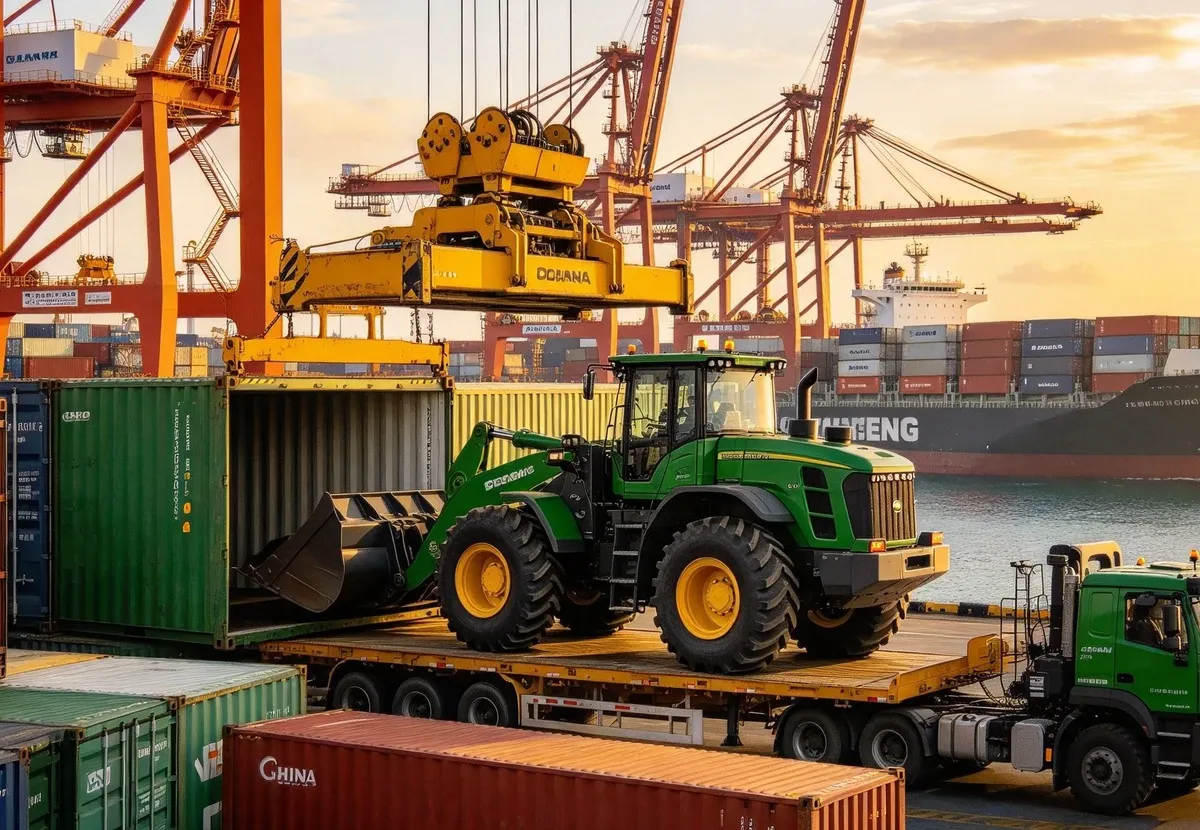
What Agricultural Machinery Can You Import from China to Kenya?
Chinese manufacturers produce a wide range of agricultural equipment suitable for Kenyan farms, from small-scale tools to large commercial machinery.
Popular Machinery Types:
- Tractors: Walking tractors (power tillers), 4WD farm tractors (50-180 HP), and mini tractors for smallholder farms
- Combine Harvesters: Wheat, rice, and maize harvesters with cutting widths from 1.5m to 4m
- Tillage Equipment: Disc ploughs, cultivators, harrows, and rotary tillers
- Seeding & Planting Machines: Precision seeders, transplanting machines, and fertilizer spreaders
- Irrigation Systems: Diesel and electric water pumps, drip irrigation equipment, and sprinklers
- Post-Harvest Equipment: Threshers, grain dryers, rice mills, and maize shellers
Tractor Parts & Accessories:
- Engine components (pistons, cylinders, gaskets)
- Hydraulic systems (pumps, cylinders, hoses)
- Transmission and clutch parts
- Implements and attachments (blades, buckets, mowers, loaders)
- Wear parts (filters, belts, tires, batteries)
Why Import from China?
- Price Advantage: Chinese equipment often offers a lower upfront purchase cost than comparable European or American brands
- Compatibility: Massey Ferguson and John Deere compatible parts widely available
- Manufacturing Hubs: Major production centers in Shandong, Jiangsu, Henan, and Hebei provinces
- Lead Times: Standard models can often be ready within a few weeks, while customized units usually take longer
Our Industry Insight: In our experience shipping farm equipment from China since 2013, we’ve noticed that Kenyan buyers increasingly prefer new Chinese machinery over used European equipment. New machines offer warranty support, easier parts availability, and simpler compliance with Kenya’s Pre-Export Verification of Conformity (PVoC) requirements.
Used Tractor Import Regulations Kenya: What You Need to Know
Importing used agricultural machinery to Kenya involves additional restrictions compared to new equipment.
Age Restrictions:
- Kenya applies strict age and compliance rules to some used vehicles and special-purpose units, but treatment can vary by equipment type and registration category
- Before buying used agricultural machinery, confirm the current position with Kenya Bureau of Standards (KEBS) and your clearing agent
- “Refurbished” or “reconditioned” units require special documentation and inspection
Pre-Shipment Inspection Requirements:
Used equipment requires mandatory inspection by KEBS-approved agents in China:
- Approved Agents: Cotecna, Intertek, SGS
- Certificate of Conformity (CoC): Required before shipment
- Inspection Covers: Functionality testing, safety standards, emissions compliance, serial number verification
Cost Implications:
- Used machinery may attract different duty treatment from new equipment depending on HS code, valuation, and condition
- Depreciation calculations affect customs valuation
- Inspection and compliance fees vary by agency and shipment scope
- Additional documentation requirements increase clearance time
Recommendation for First-Time Importers:
New machinery simplifies compliance, offers warranty protection, and eliminates age verification complications. If you’re new to importing, start with new equipment. Used machinery requires experienced freight forwarders familiar with Kenyan regulations and pre-shipment inspection procedures.
Choosing the Right Shipping Method: Sea Freight vs. Air Freight vs. Special Containers
Start with size and loading method first. Budget matters, but only after you know whether the cargo fits standard container equipment or needs flat rack, open top, or RoRo service.
Sea Freight from China to Kenya for Tractor Parts (FCL vs. LCL)
For most heavy machinery and bulk farm equipment, sea freight remains the most practical choice because it offers the best balance of capacity and cost.
FCL (Full Container Load) is ideal for larger shipments:
- 20ft Standard Container: Fits 1-2 small tractors or 25-28 CBM of parts
- 40ft High Cube Container: Fits 3-4 tractors or 55-58 CBM of parts
- Advantages: Lower per-unit cost, faster clearance, reduced handling damage
LCL (Less than Container Load) works for smaller volumes:
- Best For: 1-13 CBM of parts, single small machines
- Rate: $70-150 per CBM (freight only, 2026 rates)
- Important: Charged on greater of actual weight or volume (1 CBM = 1,000 kg)
- Disadvantages: Longer transit time (consolidation/deconsolidation), higher damage risk
Flat Rack Container Shipping China to Kenya for Oversized Farm Machinery
When to Use Flat Rack:
Equipment exceeding standard container dimensions (width >2.35m, height >2.39m, or irregular shapes):
- Combine harvesters with wide headers
- Large tractors with cabs and front loaders
- Sprayers, balers, and oversized implements
Specifications:
- 20ft Flat Rack: 20’ x 8’ x 8’6” (collapsible or fixed ends)
- 40ft Flat Rack: 40’ x 8’ x 8’6”
Cost: Base ocean freight + $800-1,500 OOG (Out of Gauge) surcharge
Securing Cargo: Professional lashing, chocking, and weatherproofing required to prevent shifting during ocean transit.
RoRo (Roll-on/Roll-off) Shipping for Drivable Agricultural Machinery
Best For: Self-propelled equipment that can be driven onto the vessel:
- Tractors (all sizes)
- Combine harvesters
- Self-propelled sprayers
Advantages:
- No container needed—drive on/drive off
- Often cheaper than flat rack for heavy machinery
- Faster port handling (no crane lifts required)
Disadvantages:
- Limited sailings to Mombasa (less frequent than container ships)
- Vessel schedule constraints
- Exposure to weather during transit (requires protective coating)
Cost: $80-120 per cubic meter or per unit basis (varies by shipping line)
Open Top Container for Tall Farm Equipment
When to Use: Machinery taller than 2.39m but within standard width/weight limits:
- Tractors with tall exhaust stacks
- Grain augers and conveyors
- Tower sprayers
Loading: Top-loading by crane or forklift with tarpaulin cover for weather protection.
Air Freight Agricultural Machinery China to Kenya
Best For: Urgent spare parts, small high-value components, prototype machinery
Key Details:
- Transit Time: Air freight is typically much faster than sea freight, often around 3-7 days airport-to-airport under normal conditions
- Cost: Air freight is usually quoted in the mid-single to low-double-digit USD per kg range, depending on volume, season, and airline space
- Chargeable Weight: Greater of actual weight vs. volumetric weight (L×W×H÷6000)
- Origin Airports: Guangzhou (CAN), Shanghai (PVG), Shenzhen (SZX), Hong Kong (HKG)
- Destination: Jomo Kenyatta International Airport (NBO), Nairobi
Restrictions: Batteries, liquids, and pressurized systems require special handling and MSDS (Material Safety Data Sheet) documentation.
If downtime is your main concern, air freight is usually reserved for urgent replacement parts rather than full machines.
Shipping Method Decision Matrix
| Equipment Type | Volume/Weight | Recommended Method | Transit Time | Cost Level |
|---|---|---|---|---|
| Tractor parts, filters, belts | <2 CBM | Air freight or LCL | 3-7 days (air) / 30-40 days (LCL) | $$$ (air) / $ (LCL) |
| Single small tractor | 5-10 CBM | LCL or 20ft FCL | 30-40 days | $$ |
| 2-3 mid-size tractors | 15-25 CBM | 20ft or 40ft FCL | 25-35 days | $$ |
| Large tractor with loader | >3m width | 40ft Flat Rack | 28-40 days | $$$ |
| Combine harvester | >15 CBM, non-standard | RoRo or 40ft Flat Rack | 25-35 days | $$$ |
| Urgent repair parts | <500 kg | Air freight (express) | 3-5 days | $$$$ |
How Much Does It Cost to Ship Agricultural Machinery from China to Kenya?
Most first-time buyers focus too much on the ocean freight line and not enough on what happens after arrival. The figures below are best used as working market ranges, because final pricing shifts with seasonality, routing, carrier space, destination charges, and inland delivery.
For a market-specific pricing reference, you can also compare our latest analysis on freight costs from china to Kenya.
Sea Freight Rates (Port-to-Port, USD)
| Origin Port | 20ft FCL | 40ft FCL | 40ft HC | LCL (per CBM) | Transit Time |
|---|---|---|---|---|---|
| Shenzhen/Guangzhou | $1,900-2,500 | $3,700-4,400 | $3,900-4,700 | $70-120 | 25-35 days |
| Shanghai/Ningbo | $2,000-2,600 | $3,800-4,500 | $4,000-4,700 | $80-130 | 28-36 days |
| Qingdao/Tianjin | $2,900-3,900 | $4,200-5,600 | $4,800-6,000 | $90-150 | 28-40 days |
These are indicative market estimates only. Peak season surcharges, equipment shortages, and transshipment routing can materially change the final quote.
Air Freight Rate Estimates
| Weight Bracket | Estimated Rate per kg | Example: 100 kg shipment |
|---|---|---|
| 45-100 kg | $6.00-9.00 | $600-900 |
| 100-300 kg | $5.00-7.00 | $500-700 |
| 300 kg+ | $4.00-6.00 | $400-600 |
| Express (DHL/FedEx) | $8.00-12.00 | $800-1,200 |
Kenya Import Duty on Agricultural Machinery (2026)
HS Code Classification (Critical for duty calculation):
| HS Code | Description | Typical Duty Rate | VAT |
|---|---|---|---|
| 84.29 | Self-propelled agricultural tractors | 0-10% | 16% |
| 84.31 | Parts of agricultural machinery | 0-10% | 16% |
| 84.32 | Soil preparation, planting machinery | 0-10% | 16% |
| 84.33 | Harvesting, threshing machinery | 0-25% | 16% |
| 84.34 | Milking machines, dairy machinery | 0-10% | 16% |
| 87.16 | Agricultural trailers | 10-25% | 16% |
EAC Common External Tariff Bands:
- 0%: Raw materials, capital goods (many agricultural machines qualify)
- 10%: Intermediate goods
- 25%: Finished industrial products
- 35%: Consumer goods
Additional Charges (calculated on CIF value):
- Import Declaration Fee (IDF): 2.5%
- Railway Development Levy (RDL): 2%
- VAT: 16% (applied on CIF + duty + IDF + RDL)
Effective tax rate even at 0% duty: approximately 22%
Sample Landed Cost Calculation
Scenario: Import 1 used 80HP tractor + spare parts from Qingdao to Nairobi
| Cost Component | Amount (USD) | Notes |
|---|---|---|
| Machine price (FOB) | $12,000 | 2019 model, good condition |
| Export clearance + docs | $200 | Chinese export fees |
| Ocean freight (20ft FCL) | $3,200 | Qingdao to Mombasa |
| Marine insurance | $150 | 0.5% of CIF value |
| CIF Value | $15,550 | Cost + Insurance + Freight |
| Duty (10% for used tractor) | $1,555 | HS 84.29, used equipment rate |
| IDF (2.5% of CIF) | $389 | Mandatory |
| RDL (2% of CIF) | $311 | Mandatory |
| VAT (16% on CIF+duty+IDF+RDL) | $2,817 | Calculated on $17,805 |
| Clearing agent + port fees | $450 | Mombasa CFS charges |
| Mombasa to Nairobi transport | $800 | SGR or truck |
| Total Landed Cost | $21,872 | ~82% above FOB price |
Practical Example: When buyers order several tractors at once, the cheapest-looking option is not always the cheapest in the end. Consolidating multiple units into one
40ft High Cubecontainer can reduce handling risk, simplify paperwork, and lower total freight spend compared with splitting the order into separate LCL moves. The catch is timing: if PVoC inspection is still unresolved when the cargo is ready, the saving on freight can disappear into delay costs.
How Long Does It Take to Ship Farm Equipment from China to Kenya?
Transit time on this lane is driven as much by paperwork as by the vessel schedule.
Transit Time by Method
| Shipping Method | Port-to-Port | Door-to-Door | Best For |
|---|---|---|---|
| Air Freight | Typical 3-7 days | Typical 7-14 days | Urgent parts, small machinery |
| Sea Freight (FCL) | Typical 25-35 days | Typical 30-45 days | Full container loads |
| Sea Freight (LCL) | Typical 28-40 days | Typical 35-50 days | Small shipments |
| RoRo | Typical 25-35 days | Typical 30-40 days | Drivable machinery |
Detailed Sea Freight Timeline (Day-by-Day)
| Phase | Duration | Key Activities |
|---|---|---|
| Factory pickup & consolidation | 2-5 days | Collect from supplier, deliver to port/warehouse |
| China export clearance | 1-3 days | Customs declaration, inspection (if required) |
| Ocean transit to Mombasa | 23-35 days | Direct sailing or transshipment (Jebel Ali, Colombo) |
| Mombasa discharge & port handling | 1-3 days | Vessel unloading, container positioning |
| KNRA radiation screening | Allow 1-2 extra days | Industry reports indicate this may now form part of Mombasa planning |
| KRA customs clearance | 3-7 days | Document verification, duty payment, inspection |
| Inland transport to Nairobi | 1-2 days | SGR rail (8 hours) or truck (6-8 hours) |
| Total Door-to-Door | 35-55 days | Plan for delays during peak season or CNY |
Common Delay Factors
- Chinese New Year (Jan-Feb): Book 3-4 weeks in advance; factories and ports slow down
- Peak Season (June-September): Space constraints, rate increases
- Mombasa Port Congestion: Occurs during high import periods
- Documentation Errors: Missing PVoC, incorrect HS codes, ACD reference issues
- Weather: Indian Ocean monsoon (May-September) can affect sailings
Packaging and Protecting Agricultural Machinery for Sea Freight
Proper packaging is essential to prevent corrosion and damage during ocean transit.
Metal Components: Rust Prevention
- VCI (Volatile Corrosion Inhibitor) paper wrapping: Essential for exposed metal parts
- Rust-preventive oil/coating: Apply to hydraulic cylinders, PTO shafts, implements
- Desiccant packs: Place inside crates and containers (silica gel, 500g per cubic meter)
- Cocoon packaging: Heat-shrunk plastic with dehumidifiers for high-value machinery
Hydraulic Systems
- Fluid drainage: Completely drain hydraulic oil and coolant (environmental regulations)
- Seal openings: Cap all hydraulic ports, cylinders, and reservoirs
- Pressure relief: Release pressure from accumulators and sealed systems
Tires and Mobility
- Deflate partially: Reduce tire pressure by 30% to prevent damage from temperature changes
- Chock and brace: Secure wheels, axles, and attachment points
- Remove attachments: Ship loaders, buckets, and implements separately if possible
Wooden Crates and ISPM 15 Compliance
- Heat treatment (HT): All wooden packaging must be heat-treated (56°C for 30 minutes) or fumigated (MB)
- ISPM 15 stamp: Required on all wood packaging material (crates, pallets, dunnage)
- Alternative: Use plastic or metal packaging to avoid ISPM 15 requirements
- Documentation: Fumigation certificate required for customs clearance
Pre-Shipment Inspection Checklist
- All metal surfaces coated with rust inhibitor
- Hydraulic systems drained and sealed
- Batteries disconnected and terminals insulated
- Tires deflated and secured
- Loose parts removed and packaged separately
- Operator manuals and documents waterproofed
- Serial numbers photographed and documented
- ISPM 15 compliant wooden crates
- Container loading photos taken (before closing doors)
Our Industry Insight: In our 10+ years shipping machinery to East Africa, we have seen the same mistake again and again: buyers spend heavily on the machine, then try to save a small amount on packing protection. Mombasa’s humid coastal conditions are unforgiving. Proper rust-proofing for exposed metal surfaces is almost always cheaper than replacing damaged hydraulic cylinders, PTO shafts, or electrical components after arrival.
Kenya Import Compliance for Agricultural Machinery: Documents, HS Codes, and Customs
Required Documentation Checklist
- Commercial Invoice: Shows actual transaction value (under-invoicing triggers penalties)
- Packing List: Detailed weights, dimensions, contents per package
- Bill of Lading (B/L): Ocean freight contract of carriage
- Certificate of Origin (CO): Form E for EAC preferential rates (if applicable)
- Certificate of Conformity (CoC): PVoC certificate from KEBS-approved agent
- Import Declaration Form (IDF): Filed with KRA before shipment
- Advance Cargo Declaration (ACD): Mandatory 15-digit reference code since August 2026
- Fumigation Certificate: For wooden packaging (ISPM 15)
- Insurance Certificate: For current Kenya-bound compliance planning, confirm whether the policy must be issued through a Kenyan-licensed insurer
- KRA PIN: Importer’s tax identification number
PVoC (Pre-Export Verification of Conformity) Explained
Kenya requires pre-shipment inspection for regulated products, including agricultural machinery.
Approved Agents in China: Cotecna, Intertek, SGS
Three Routes:
- Route A: Batch inspection per shipment (occasional importers)
- Route B: Product registration + periodic inspection (regular importers)
- Route C: Manufacturer quality system certification (high-volume exporters)
Timeline: 5-10 working days for inspection and certificate issuance
Cost: $300-800 per shipment
Consequences of Non-Compliance:
- Destination inspection in Kenya (7-10 days delay)
- Additional fee: 0.6% of approved customs value
- Possible penalty: up to 15% of CIF value or re-export
2026 Regulatory Updates (Must-Know)
- ACD Requirement: All containerized imports require 15-digit ACD reference from KRA (effective August 3, 2026)
- Marine Insurance: Must be placed with Kenyan-licensed insurers (effective July 1, 2026)
- KNRA Radiation Screening: Industry reporting in 2026 suggests Mombasa screening can add about 1-2 working days to sea freight clearance planning
- Certificate of Origin: Requirements vary by product, tariff treatment, and origin claim, so confirm current document needs before shipment
Step-by-Step: How to Import Farm Machinery into Kenya from China
If you follow the order below, the process stays manageable. If you reverse it and book freight before confirming compliance and packed dimensions, problems tend to multiply quickly.
Step 1: Supplier Verification and Selection (Week 1-2)
- Verify business license and manufacturing scope
- Request live video call from production floor
- Compare 3+ quotes for same specifications
- Confirm power requirements (Kenya: 240V/50Hz, Type G plugs, 3-phase for large machines)
- Check spare parts availability and after-sales support
Step 2: Pre-Shipment Preparation (Week 2-3)
- Obtain proforma invoice with exact specifications
- Confirm packed dimensions and gross weight
- Arrange PVoC inspection and CoC certificate
- Prepare commercial invoice and packing list
- Decide Incoterms:
- FOB (Free on Board): You control ocean freight and insurance
- CIF (Cost, Insurance, Freight): Supplier arranges to Mombasa
- DDP (Delivered Duty Paid): Door-to-door, all-inclusive (recommended for beginners)
Step 3: Booking and China Export (Week 3-4)
- Book freight with forwarder
- Factory pickup and delivery to port/warehouse
- China export customs clearance (1-3 days)
- Obtain ACD reference and confirm on B/L
Step 4: Ocean/Air Transit (Week 4-10)
- Track shipment
- Prepare Kenyan import documents:
- IDF filing with KRA
- Engage licensed clearing agent
- Arrange duty/tax payment funds
Step 5: Mombasa Arrival and Customs Clearance (Week 10-12)
- Vessel arrival and discharge (1-3 days)
- KNRA radiation screening (1-2 days)
- KRA customs clearance (3-7 days)
- Release order from shipping line
Step 6: Inland Delivery (Week 12)
- Transport from Mombasa to Nairobi/destination:
- SGR Rail: 8 hours to Nairobi ICD, $400-800 per container
- Trucking: 6-8 hours, $600-1,200 (flexible for rural destinations)
Common Mistakes to Avoid When Importing Agricultural Machinery
| Mistake | Consequence | Solution |
|---|---|---|
| Wrong HS Code | Overpaid duty or KRA penalties | Verify with clearing agent before shipping |
| Skipping PVoC | 7-10 day delay + destination inspection fees | Arrange CoC in China before shipment |
| Under-Declaring Value | Seizure, fines, blacklisting | Always declare actual transaction value |
| Ignoring Power Requirements | Machine unusable in Kenya | Confirm 240V/50Hz compatibility |
| Inadequate Rust Protection | Corroded machinery on arrival | Use VCI paper, desiccants, proper crating |
| No Spare Parts Shipment | Downtime waiting for parts | Include 1-2 years of wear parts |
| Missing ACD Reference | Cargo won’t load at origin | Ensure ACD on B/L before departure |
| No Cash for Duty Payment | Storage/demurrage charges | Prepare 20-30% of CIF value |
| Choosing Cheapest Forwarder | Hidden fees, delays, no support | Evaluate forwarders using 8-point checklist |
Why Choose Sinoshipment for Your Agricultural Machinery Shipment?
At Sinoshipment, we’ve been helping importers ship agricultural machinery from China to Kenya since 2013. With over 5,000 successful shipments and deep expertise in East African logistics, we understand the unique challenges of farm equipment transportation.
Our Advantages:
- 10+ Years China-Africa Experience: Specialized in East African routes since 2013
- 5,000+ Successful Shipments: Trusted by farmers, contractors, and dealers across Kenya
- Multi-Port Operations: Shenzhen, Guangzhou, Shanghai, Ningbo, Qingdao, Tianjin
- Special Equipment Expertise: Flat rack, RoRo, and OOG cargo handling
- Door-to-Door DDP Service: Hassle-free delivery to Nairobi, Nakuru, Eldoret, and beyond
- PVoC Coordination: We arrange CoC inspections with KEBS-approved agents
- Transparent Pricing: No hidden fees—itemized quotes with validity periods
- Cargo Insurance: Full-value coverage with reputable underwriters
- Local Kenya Network: Licensed clearing agents in Mombasa and Nairobi
Practical Example: Tall harvesters are not just a loading problem. They are also a protection and inspection problem. When a shipment needs
40ft Open Topequipment, tarpaulin quality, corrosion control, and hydraulic sealing become just as important as the booking itself. That is why experienced importers treat published door-to-door timing as a working range, not as a promise.
If you already have machine specs and packed dimensions, get a free quote from Sinoshipment and we can help you check the right loading method, compliance requirements, and delivery setup before you book.
FAQ
How much does it cost to ship a tractor from China to Kenya?
For budgeting purposes, a standard 80HP tractor in a 20ft container from Qingdao to Mombasa will usually land in the low-thousands USD range for ocean freight alone. The bigger surprise for many buyers is the landed cost to Nairobi once duty, levies, VAT, insurance, and inland delivery are added, so always price the full move rather than the sea leg by itself.
How long does it take to ship agricultural machinery from China to Kenya?
As a working rule, many importers plan sea freight at roughly 25-35 days port-to-port and 35-55 days door-to-door, while urgent parts by air are commonly planned at around 3-7 days. In practice, the biggest time loss usually comes from transshipment, late paperwork, or clearance delays rather than the pure sailing time.
Do I need PVoC certification for agricultural machinery?
Yes, most agricultural machinery requires PVoC (Pre-Export Verification of Conformity). You must obtain a Certificate of Conformity (CoC) from KEBS-approved agents (Cotecna, Intertek, SGS) in China before shipment. Without it, your cargo faces destination inspection, delays, and penalties.
Can I import used tractors to Kenya?
Yes, but with restrictions. Used tractors and other second-hand agricultural equipment may face extra inspection, valuation, and compliance checks, and the applicable age rule can depend on how the unit is classified. Verify the current KEBS position and import eligibility before you pay the supplier.
What is the import duty on agricultural machinery in Kenya?
Duty rates vary by HS code: tractors (84.29) typically 0-10%, harvesters (84.33) 0-25%, parts (84.31) 0-10% under EAC Common External Tariff. Additionally, you’ll pay 2.5% IDF, 2% RDL, and 16% VAT, resulting in ~22% total tax even at 0% duty.
Can I ship tractor parts and a complete machine together?
Yes, you can consolidate parts and machinery in the same container (FCL) or shipment. This is cost-effective for LCL shipments. Ensure parts are properly packed to prevent damage to the main machine during transit.
What is the ACD requirement for Kenya imports?
Since August 3, 2026, all containerized imports to Kenya require a 15-digit Advance Cargo Declaration (ACD) reference code from KRA. This must be obtained at the point of loading in China and printed on the Bill of Lading. Without it, your cargo won’t be loaded onto the vessel.
Should I choose FOB, CIF, or DDP shipping terms?
- FOB: You control ocean freight and insurance (best if you have experience)
- CIF: Supplier arranges freight to Mombasa (you handle clearance)
- DDP: Door-to-door, all-inclusive (recommended for first-time importers; Sinoshipment specializes in DDP to Kenya)
Shipping agricultural machinery from China to Kenya is rarely difficult for one single reason. It becomes difficult when container choice, compliance, paperwork, and inland delivery are handled as separate decisions instead of one import plan. If you line those pieces up early, you give yourself a much better chance of landing the cargo on time, within budget, and without unnecessary clearance trouble.