Aqaba Port vs Amman Airport: The Complete Shipping Comparison Guide (2026)
· By SinoShipment
Every shipment from China to Jordan faces a fork in the road: Aqaba Port vs Amman Airport. Jordan has exactly one commercial seaport — Aqaba, on the Red Sea — and one primary air gateway — Queen Alia International Airport (AMM), about 30 km south of Amman. There is no third option. Choose the right entry point and your cargo arrives on time and on budget. Choose wrong and you’re looking at weeks of delay or thousands of dollars in unnecessary costs.
At Sinoshipment, we’ve spent over a decade managing freight shipping from China to Jordan across both sea and air routes. Most guides describe both routes separately and leave you to connect the dots. We put them head-to-head — real costs, real transit times, and a decision framework you can actually use.
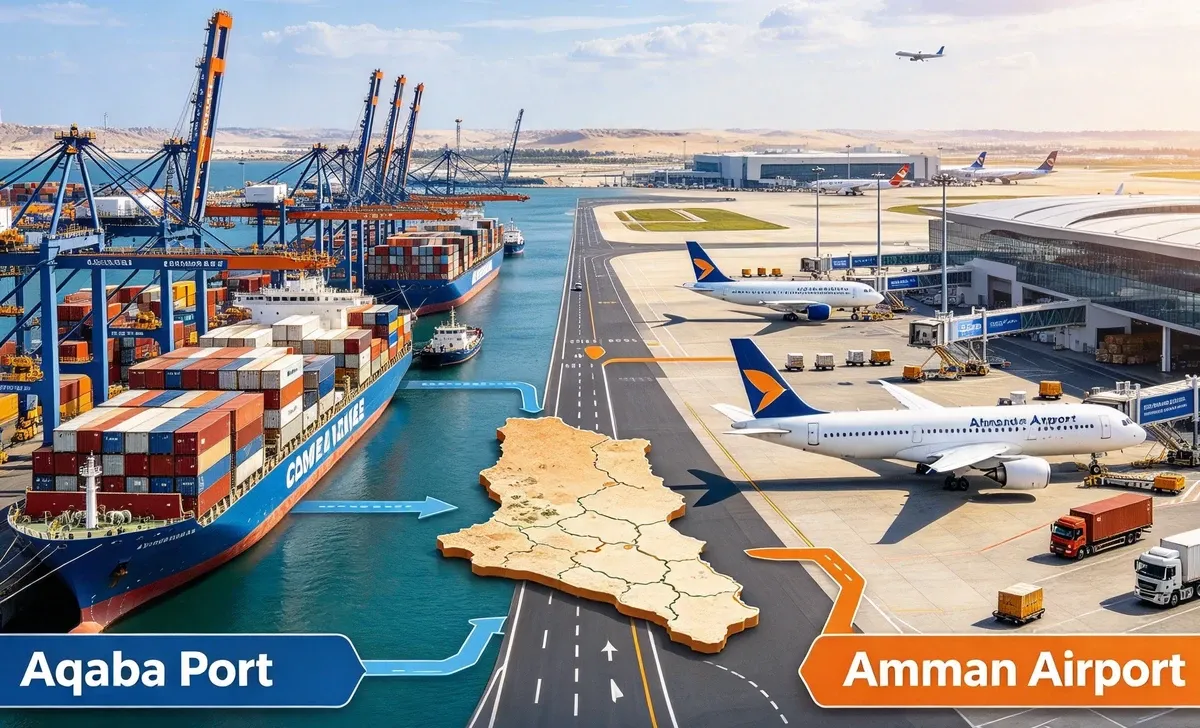
Quick Answer: Aqaba Port or Amman Airport?
Here’s the short version. If your cargo weighs more than 500 kg, isn’t urgently needed, and cost matters more than speed → ship via Aqaba Port (sea freight). If it’s under 500 kg, high-value, time-sensitive, or perishable → fly it into Amman Airport (air freight).
| Factor | Aqaba Port (Sea) | Amman Airport (Air) |
|---|---|---|
| Best for | >500 kg, non-urgent | <500 kg, urgent, high-value |
| Transit (door-to-door) | 30–45 days | 5–12 days |
| Cost basis | Per container / CBM | Per kg (chargeable weight) |
| Complexity | Higher (trucking + clearance) | Lower (arrives at destination city) |
The full breakdown is below. But if you already know your cargo profile, this table is your answer.
Understanding Jordan’s Two Gateways
Jordan’s logistics setup is unusual, and most importers don’t realize it until they’re already committed: one port, one airport, no alternatives.
Aqaba Port (JOAQJ): Jordan’s Only Seaport
Aqaba sits at the northern tip of the Gulf of Aqaba on the Red Sea. The Aqaba Container Terminal (ACT), operated by APM Terminals, handles approximately one million TEU annually with a designed capacity of 1.3–1.5 million TEUs. It processes FCL, LCL, bulk cargo, and RoRo (Roll-on/Roll-off) vehicles.
What makes Aqaba strategically important beyond Jordan is its position as a re-export corridor. Goods cleared at Aqaba can truck north to Amman (330 km), continue to Iraq via the Arar crossing (Baghdad in 3–4 days), or reach Syria through the Jaber-Nasib border. For importers serving multiple Middle East markets from a single shipment, this is a genuine advantage.
Queen Alia International Airport (AMM): The Air Gateway
Queen Alia International Airport is located roughly 30 km south of Amman and serves as Jordan’s primary air cargo hub. Royal Jordanian Cargo operates the on-site terminal, with additional capacity from Emirates SkyCargo, Qatar Airways Cargo, Turkish Cargo, and Etihad Cargo.
Royal Jordanian is investing JOD 30 million in expanding and modernizing the AMM cargo terminal, reflecting the airport’s growing role in regional logistics. Unlike Aqaba, which requires a long inland haul to reach Amman, AMM places your cargo practically at your final destination — a significant last-mile advantage if your warehouse is in Amman, Zarqa, or Irbid.
Aqaba Port vs Amman Airport: Head-to-Head Comparison
This is the table no competitor provides. Side by side, every factor that matters:
| Factor | Aqaba Port (Sea) | Amman Airport (Air) |
|---|---|---|
| Best cargo volume | >500 kg / >1 CBM | <500 kg / <1 CBM |
| Port-to-port transit | 20–36 days (origin-dependent) | 3–7 days |
| Door-to-door transit | 30–45 days | 5–12 days |
| Cost structure | Per container (FCL) or per CBM (LCL) | Per kg (chargeable weight) |
| FCL rate (40HQ) | $2,800–$5,000 | — |
| LCL rate | $60–$180/CBM | — |
| Air rate | — | $3.50–$9.00/kg |
| Break-even point | ~15 CBM (LCL→FCL) | ~500 kg (air vs sea) |
| Ideal cargo types | Furniture, machinery, textiles, building materials, bulk goods | Electronics, samples, fashion, perishables, urgent restocks |
| Reliability risk | Weather, Red Sea security, transshipment delays | Flight cancellations, capacity constraints |
| Customs process | JSMO + Importer’s Card + port clearance (2–4 days) | JSMO + Importer’s Card + airport clearance (1–2 days) |
| Last-mile logistics | +330 km trucking to Amman ($600–$800) | At/near destination city |
| Weekend impact | Friday–Saturday (Thu arrival = +3 days) | Same, but less severe (faster overall) |
| Insurance cost | ~0.3% of cargo value | ~0.4–0.5% of cargo value |
Our Industry Insight: The biggest mistake we see importers make isn’t choosing the wrong mode — it’s choosing based on the freight quote alone. A “cheap” $2,900 sea rate on a 40HQ can easily become $4,600 once BAF, war-risk, and peak-season surcharges land on the invoice. Always demand a line-by-line quote before comparing Aqaba vs Amman Airport options. A forwarder who won’t itemize is planning to surprise you later.
When to Choose Aqaba Port (Sea Freight)
Sea freight through Aqaba is the default choice for most China-to-Jordan cargo — and for good reason. It’s dramatically cheaper for anything over a few hundred kilograms. For a broader look at rates and routing options, see our dedicated guide to sea freight from China to Jordan.
Cost Structure: FCL and LCL Rates from China to Aqaba
FCL rates (2026):
| Container | Rate (USD) | Best For |
|---|---|---|
| 20GP | $1,800–$3,200 | Dense, heavy cargo (tiles, machinery) |
| 40GP | $2,800–$4,900 | Standard FCL |
| 40HQ | $3,000–$5,000 | Light, bulky cargo (furniture, textiles) |
| 45HC | $3,500–$5,500 | Very large or light volumetric cargo |
LCL rates run $60–$180 per CBM with a 1 CBM minimum. Once your shipment crosses roughly 15 CBM, a full 20GP container becomes cheaper than LCL on a per-unit basis. For a detailed breakdown of consolidation options, check our guide on LCL shipping from China to Jordan.
Watch for these surcharges on any Aqaba-bound quote:
| Surcharge | Typical Range | When It Applies |
|---|---|---|
| BAF (Bunker Adjustment Factor) | $180–$350 / 40HQ | Every shipment |
| PSS (Peak Season Surcharge) | $150–$400 / container | July–October, pre-Ramadan |
| War Risk Surcharge | $0–$120 / container | Red Sea security conditions |
| 20FT Overweight | $150–$250 | Cargo exceeds 21.7 metric tons |
Transit Times by Origin Port to Aqaba
Your origin port in China directly impacts both cost and transit time. The rule is simple: ship from the port closest to your supplier. The $400–$600 you save on inland China trucking usually outweighs any rate difference between ports.
| Origin Port | Port-to-Port | Best For |
|---|---|---|
| Shenzhen (Yantian/Shekou) | 20–28 days | South China suppliers, electronics |
| Guangzhou (Nansha) | 22–29 days | Pearl River Delta manufacturers |
| Shanghai | 24–32 days | East/Central China |
| Ningbo | 23–30 days | Zhejiang/Jiangsu factories |
| Qingdao | 26–36 days | Northern China |
| Tianjin | 26–36 days | Beijing-Tianjin-Hebei region |
Here’s what most guides won’t tell you: very few vessels sail direct from China to Aqaba. The majority transship through Jebel Ali (UAE), Jeddah (Saudi Arabia), or Colombo (Sri Lanka), adding 3–7 days to your transit. The notable exception is CMA CGM’s REX2 service, which has offered a direct Qingdao–Shanghai–Ningbo–Shekou–Nansha rotation to Aqaba with weekly departures since October 2025. If speed matters, ask your forwarder specifically about direct sailing options. For a broader view of regional routing, see our analysis of major ocean freight shipping routes from China to the Middle East.
Aqaba Port Operations and Fees
Once your container arrives at ACT, the following charges apply:
| Charge Item | Typical Cost | Notes |
|---|---|---|
| Destination THC | ~$310 / container | Terminal handling at Aqaba |
| Delivery Order (D/O) fee | $30–$50 | Document release |
| Port Security / ISPS | $15–$30 / container | Mandatory |
| Demurrage (after free time) | $30–$80 / day | Free time: 7 days FCL, 5 days LCL |
Aqaba Special Economic Zone (ASEZA) is worth knowing about. Goods entering the Aqaba Free Zone can qualify for reduced or exempt customs duties, a flat 5% corporate income tax for zone operators, and simplified clearance procedures. If your plan involves re-export to Iraq or Syria, routing through ASEZA can meaningfully reduce your upfront tax burden.
Inland Transport: Aqaba Port to Amman Cost and Options
This is the hidden cost that catches first-time importers off guard. Aqaba is 330 km from Amman via a desert highway corridor.
- Standard trucking: $600–$800 per container
- Transit time: 1–2 days
- What’s included: Base haulage, fuel, tolls, and basic insurance
Two seasonal factors can inflate this significantly. During the final week of Ramadan, trucking rates surge to $900–$1,200 due to driver availability constraints. And because Jordan’s weekend is Friday–Saturday, a Thursday arrival that doesn’t clear customs the same day can sit until Sunday — adding storage fees at $30–$80 per day.
When to Choose Amman Airport (Air Freight)
Air freight to AMM isn’t just faster — it’s a completely different cost structure, risk profile, and logistics experience. Here’s when it makes sense and what to expect. For a full overview of our air cargo capabilities, visit our air freight service page.
Air Freight Rates and Chargeable Weight to AMM
Airlines bill by chargeable weight — the greater of your actual gross weight and your volumetric weight:
Volumetric Weight (kg) = (Length × Width × Height in cm) ÷ 6000
Chargeable Weight = MAX(Actual Weight, Volumetric Weight)
Here’s a real example. A carton measuring 120 × 80 × 100 cm weighs 80 kg on the scale:
Volumetric Weight = (120 × 80 × 100) ÷ 6000 = 160 kg
Chargeable Weight = MAX(80, 160) = 160 kg
You pay for 160 kg — double the actual weight — because that’s the aircraft space your box occupies. This is why packaging optimization directly reduces your air freight bill.
Rate tiers from China to AMM (2026):
| Weight | Rate (USD/kg) | Notes |
|---|---|---|
| 45–99 kg | $6.00–$9.00 | Minimum chargeable band |
| 100–299 kg | $5.00–$7.00 | First meaningful rate break |
| 300–499 kg | $4.00–$6.00 | SME sweet spot |
| 500 kg+ | $3.50–$5.00 | Best rate; consolidate to reach |
Major China Origin Airports to Queen Alia (AMM)
Air cargo to Amman departs from all major Chinese international airports:
- Shanghai Pudong (PVG) — largest air cargo hub, most flight options
- Guangzhou Baiyun (CAN) — strong South China coverage
- Shenzhen Bao’an (SZX) — closest to electronics manufacturing clusters
- Beijing Capital (PEK) — North China gateway
- Hong Kong (HKG) — often the most competitive rates for consolidated cargo
Direct flights from China to AMM are limited. Most cargo transships through Gulf hubs (DXB, DOH, AUH) or Istanbul (IST), adding 1–2 days to total transit. Royal Jordanian operates direct connections from select Chinese cities, which your forwarder can confirm based on current schedules.
AMM Airport Handling and Clearance
The QAIA Cargo Terminal publishes its handling tariff publicly. Key charges include:
| Charge Item | Typical Cost | Notes |
|---|---|---|
| Terminal handling | Per kg rate (airline-paid) | Included in your freight quote |
| Porterage | JOD 2.00 / 100 kg | Charged to consignee/agent |
| Storage (after free time) | Varies by weight/duration | Max 30 days |
Customs clearance at AMM is generally faster than at Aqaba — expect 1–2 days versus 2–4 days at the port. The bigger advantage is geographic: if your final destination is Amman, Zarqa, or Irbid, there’s no 330 km trucking leg to arrange and pay for. Your cargo is effectively at your doorstep once it clears.
Special cargo note: Lithium batteries require MSDS (Material Safety Data Sheet) and UN38.3 certification for air transport. Liquids, powders, and other sensitive goods need a transport appraisal report. These aren’t optional — cargo without proper documentation will be refused at origin. If you’re shipping electronics, our guide on how to ship electronics and gadgets from China covers packaging, compliance, and carrier selection in detail.
Real Cost Comparison: Same Shipment, Two Routes
Let’s put real numbers to this. Here’s a shipment we handled recently (details anonymized): 500 kg of consumer electronics from Shenzhen to Amman, FOB value $15,000.
Route A: Sea via Aqaba Port (LCL)
| Cost Component | Amount (USD) |
|---|---|
| LCL ocean freight (~2 CBM × $90) | $180 |
| Origin charges (Shenzhen) | $80 |
| Destination THC + clearance (Aqaba) | $300 |
| Customs duty (10%) + GST (16%) | $2,800 |
| Aqaba → Amman trucking | $700 |
| Total | $4,060 |
| Transit (door-to-door) | 35–45 days |
Route B: Air via Amman Airport (AMM)
| Cost Component | Amount (USD) |
|---|---|
| Air freight (500 kg × $4.50/kg) | $2,250 |
| Origin charges (Shenzhen) | $100 |
| AMM handling + clearance | $250 |
| Customs duty (10%) + GST (16%) | $2,800 |
| Last-mile delivery (Amman) | $50 |
| Total | $5,450 |
| Transit (door-to-door) | 7–12 days |
The verdict: Air costs approximately 34% more but arrives 30+ days faster. For electronics with a strong value-to-weight ratio, that time saving often justifies the premium — especially if the goods are heading for a product launch or urgent restock.
Now flip the scenario. A 40HQ container of furniture from Shenzhen to Amman costs $4,800–$5,500 door-to-door via sea. The same volume by air would cost over $30,000. There’s no decision to make — Aqaba wins by default when cargo is bulky, heavy, or low-value-per-kg.
Our Industry Insight: A fashion retailer we work with in Amman used to default to air for every shipment. When we ran the numbers on their monthly 800 kg consolidated orders, switching to weekly sea LCL cut their logistics spend by 55% — and the only change was planning inventory 45 days ahead instead of 10. The key insight: air freight is a tool for urgency, not a default. Build a sea baseline, then use air strategically for exceptions.
Jordan Customs Clearance: Aqaba vs Amman Airport
Aqaba and Amman Airport sit on opposite ends of the country, but they answer to the same customs authority. What changes is how fast — and how painfully — your cargo gets through.
Required Documents (Same for Both Entry Points)
- Commercial Invoice — must match the packing list exactly
- Packing List — detailed item-level breakdown
- Bill of Lading (sea) or Airway Bill (air)
- Certificate of Origin — China Chamber of Commerce issued
- Insurance Certificate — if applicable
- Product-specific certificates: Halal, health, conformity (depending on cargo)
JSMO Inspection Requirements
The Jordan Standards and Metrology Organization (JSMO) enforces product standards and conducts mandatory inspections for seven categories:
- Electronics and appliances
- Toys and children’s products
- Food-contact materials
- Cosmetics
- Construction materials
- Textiles and footwear
- Automotive parts
Inspection fees run $80–$250 depending on product complexity. The critical best practice: satisfy conformity requirements before your cargo leaves China, not at the Jordanian border. We’ve seen containers sit at Aqaba for two weeks because a client assumed their supplier had handled JSMO documentation. They hadn’t.
Duties, Taxes, and the Importer’s Card
Jordan’s tax stack works like this:
- Customs duty: 0–30% depending on HS code
- GST: 16% applied on (CIF value + duty)
There’s no China-Jordan free trade agreement (FTA) — the two countries have a bilateral trade agreement, but it does not provide the tariff reductions of a modern FTA. Chinese goods are therefore assessed at standard MFN (Most-Favored-Nation) rates.
The Importer’s Card is the piece that trips up most first-time importers. Issued by Jordan’s Ministry of Industry, Trade and Supply, it’s required for any business importing commercially. Processing takes 1–4 weeks. Shipments valued over 1,000 JOD (~$1,400) must also be cleared by a licensed customs broker — self-clearance is only permitted below that threshold.
The DDP solution: A forwarder with a local Importer of Record (IOR) partner already holds an Importer’s Card and can clear goods on your behalf. Under DDP (Delivered Duty Paid) terms, you receive a single all-in quote with no customs surprises. For most SMEs without a Jordanian entity, this is the practical path forward. Sinoshipment’s customs clearance team handles the full process — from document preparation to JSMO coordination — on both the Aqaba and Amman Airport lanes.
One more thing: Jordan’s weekend is Friday–Saturday. A Thursday arrival at either Aqaba or AMM that doesn’t clear the same day will sit until Sunday. Factor this into your delivery timeline, especially during Ramadan when working hours shift.
If you’re also evaluating sea freight options beyond Jordan, our Middle East route guides cover neighboring corridors including freight shipping from China to Saudi Arabia and freight shipping from China to UAE — both of which share transshipment hubs with the Aqaba lane.
How to Decide: Decision Framework by Scenario
Here’s the framework we use with our own clients. Match your scenario to find your route:
| Scenario | Recommended Route | Why |
|---|---|---|
| Urgent restock (< 1 week) | ✈️ Amman Airport | 5–12 days D2D; sea can’t compete |
| New product launch / samples | ✈️ Amman Airport | Speed matters more than cost for small volumes |
| Bulk inventory / seasonal stock | 🚢 Aqaba Port | Lowest per-unit cost for >15 CBM |
| High-value electronics (< 500 kg) | ✈️ Amman Airport | Value-to-weight ratio justifies air premium |
| Furniture / building materials | 🚢 Aqaba Port | Bulky, heavy; air economically impractical |
| Perishables / food products | ✈️ Amman Airport | Shelf-life constraint makes sea non-viable |
| E-commerce small parcels | ✈️ Amman Airport (or express) | < 100 kg; speed drives customer satisfaction |
| Re-export to Iraq/Syria | 🚢 Aqaba Port (ASEZA) | Gateway positioning; land routes to Baghdad in 3–4 days |
| Budget-constrained, flexible timeline | 🚢 Aqaba Port | Cheapest option for any volume > 1 CBM |
The pattern is clear: air freight is for speed, sea freight is for scale. If you’re shipping under 500 kg and need it fast, AMM is your answer. If you’re shipping over 1 CBM and can plan ahead, Aqaba will save you serious money.
FAQs
Which is cheaper: Aqaba Port or Amman Airport?
Aqaba is almost always cheaper for shipments over ~500 kg or 1 CBM. For very small parcels under 45 kg, express courier services (DHL/UPS/FedEx) may be competitive with standard air freight.
How long does sea freight take from China to Aqaba?
20–28 days port-to-port from Shenzhen or Guangzhou; 24–36 days from Shanghai, Ningbo, or Qingdao. Door-to-door adds 8–12 days for customs clearance and inland trucking to Amman.
How long does air freight take from China to Amman?
3–7 days airport-to-airport; 5–12 days door-to-door including customs clearance and final delivery.
Do I need an Importer’s Card to clear cargo in Jordan?
Yes, for commercial shipments. If you don’t have one, use a DDP forwarder with a local Importer of Record (IOR) who already holds the card and can clear goods on your behalf.
What is JSMO inspection and will it affect my shipment?
JSMO (Jordan Standards and Metrology Organization) inspects regulated product categories including electronics, toys, cosmetics, and textiles. Expect $80–$250 in fees and potential delays if documentation is incomplete. Prepare all conformity documents before your cargo leaves China.
Can I ship lithium batteries via air to Amman?
Yes, but you need MSDS and UN38.3 certification. Some carriers restrict battery cargo on passenger aircraft. Your forwarder can route via cargo-only flights to ensure compliance.
What is the cheapest way to ship from China to Jordan?
Sea freight LCL for 1–15 CBM; sea freight FCL for 15+ CBM. The key cost lever is choosing the origin port closest to your supplier to minimize inland China trucking charges.
Is there a free trade agreement between China and Jordan?
No. Goods from China are assessed at standard MFN (Most-Favored-Nation) tariff rates, ranging from 0–30% depending on the HS code.
Why Ship China to Jordan with Sinoshipment
The right gateway depends on your cargo, your timeline, and your budget — and the wrong choice is expensive. At Sinoshipment, we’ve been managing China-to-Jordan shipments since 2013, serving over 5,000 clients across sea, air, and DDP door-to-door services.
Here’s what that experience means for you:
- Unbiased recommendations: We operate both sea and air routes, so we recommend based on your needs — not our capacity. If Aqaba is the right answer, we’ll tell you. If Amman Airport makes more sense, we’ll tell you that too.
- Shenzhen headquarters: Located minutes from Yantian and Shekou ports, with direct carrier contracts on the Aqaba lane and consolidation services for AMM-bound air cargo.
- DDP expertise: Our Jordanian IOR partner handles the Importer’s Card, JSMO coordination, and customs clearance — so you never touch the paperwork.
- Transparent pricing: Line-by-line quotes with every surcharge itemized upfront. No surprises at invoice time.
Ready to ship? Get a free quote for your China-to-Jordan shipment and we’ll recommend the optimal route within 24 hours.